8 min read
From East Asia to the Indo-Pacific: Japan's Defense Doctrine Transformation and Its Growing Security with Türkiye
Japan is quietly reshaping its defense doctrine, strengthening deterrence while extending its security outlook from East Asia toward the Indo-Pacific and Euro-Atlantic. Its growing defense-industry partnership with Türkiye is emerging as one of the most notable dimensions of this shift.
- Japan
- Defense Industry
- Indo-Pacific
- Türkiye
- NATO
- Security Partnership
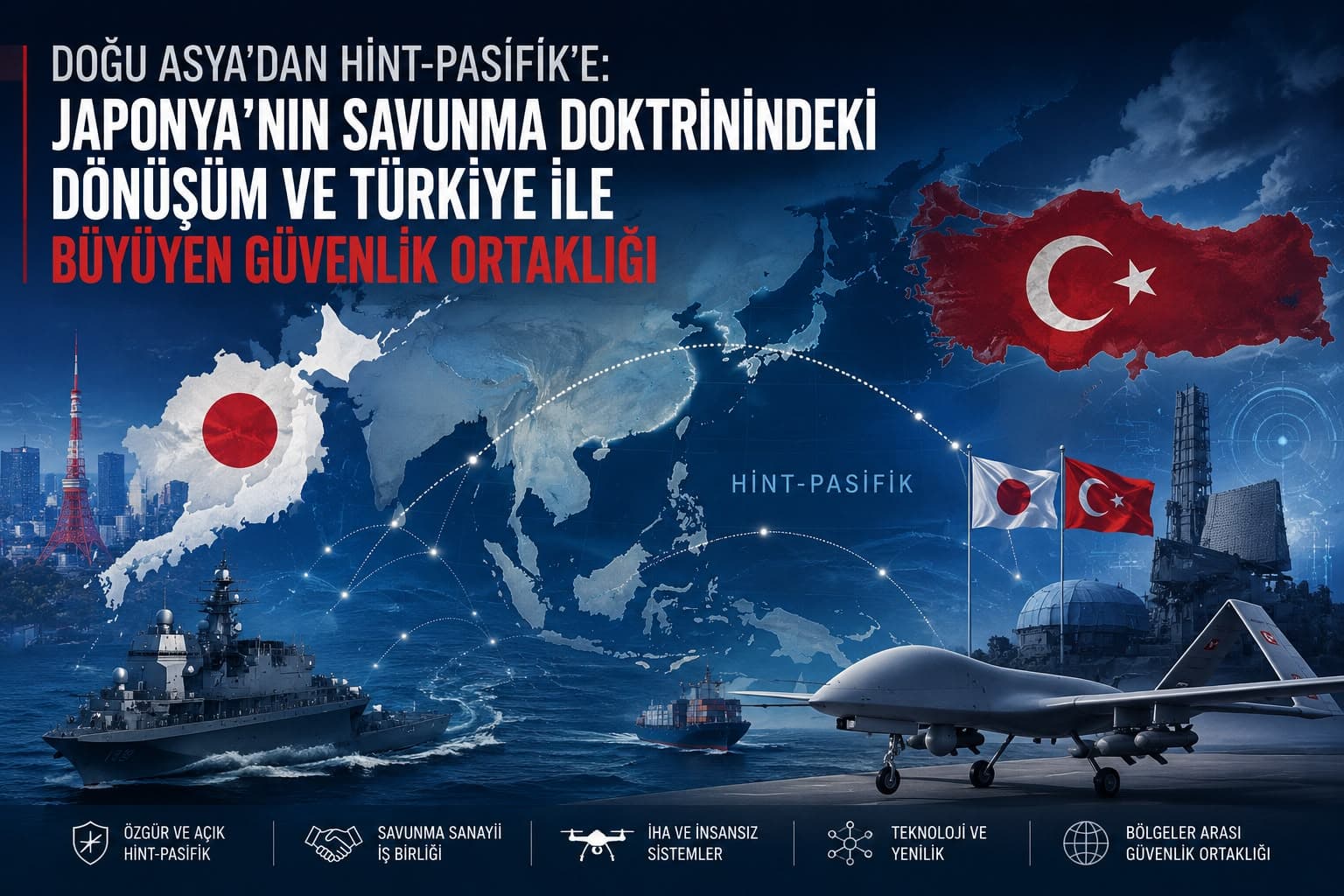
Japan's defense policy has undergone a quiet but far-reaching transformation in recent years. While preserving the legal boundaries of the pacifist security framework shaped after World War II, Tokyo is moving toward a more active posture aimed at expanding defense capacity, strengthening deterrence, and diversifying its security partnerships.
This transformation is not limited to threats in Japan's immediate neighborhood. Tokyo now frames its security outlook within a much broader context, stretching from East Asia to the Indo-Pacific and onward to the Euro-Atlantic security space. The growing defense and security relationship with Türkiye is one of the most notable dimensions of this new strategic approach.
A New Era in Japan's Defense
The most significant shift in Japan's defense policy is the move from a purely reactive posture to a stronger deterrence model. China's rising military capacity, tension in the Taiwan Strait, competition in the East China Sea, North Korea's missile program, and Russia's military activity in the Asia-Pacific are directly shaping Tokyo's defense planning.
Japan's 2022 National Security Strategy and National Defense Strategy laid the groundwork for this shift, prioritizing stand-off defense capability, integrated air and missile defense, unmanned systems, space, cyber domain, electromagnetic warfare, and command-control and intelligence functions.
The Japanese Ministry of Defense's 2025 Defense White Paper outlines future defense capacity around seven core pillars:
- Stand-off defense capability.
- Integrated air and missile defense.
- Unmanned-systems-based defense capacity.
- Cross-domain operations.
- Command, control, and intelligence functions.
- Rapid deployment and civil protection.
- Sustainability and resilience.
Counterstrike capability is also viewed as a key deterrence element. Tokyo emphasizes that this capability does not imply preemptive strikes; rather, it represents the minimum necessary measure of self-defense, within constitutional and legal limits, to halt an ongoing armed attack against Japan.
The critical point is that Japan is not pivoting toward an offensive military doctrine. Tokyo maintains it remains defense-oriented and bound by legal limits. Still, the advance of missile technology, hypersonic weapons, unmanned systems, and cyberattacks reinforces the view that a purely reactive defense posture may no longer be sufficient.
AI and Unmanned Systems
One of the most visible areas of Japan's defense transformation is unmanned systems and AI technologies. The 2026 Defense White Paper places special emphasis on the mass use of unmanned systems and protracted conflicts as part of "new forms of warfare." Japan also aims to strengthen its defense production base, technological capacity, and supply-chain resilience.
Tokyo's plans emphasize the combined use of unmanned aerial, surface, and underwater vehicles. Japan aims to establish the SHIELD system — "Synchronized, Hybrid, Integrated and Enhanced Littoral Defense" — within fiscal year 2027, designed around the coordinated use of numerous low-cost unmanned platforms for coastal defense.
This approach is directly tied to Japan's security environment. Its long coastline, island geography, and dependence on maritime transport routes make coastal surveillance and early-warning systems critical. Unmanned vehicles can ease pressure on human resources in tasks such as monitoring wide areas, patrolling risky zones, target detection, and logistics support.
For Japan, these technologies are not solely about boosting military capacity. The country's aging population and difficulties in recruiting defense personnel are also accelerating the shift toward unmanned systems, with the Ministry of Defense focusing on expanding AI use in command-control processes and unmanned platforms.
From East Asia to the Indo-Pacific
Reading Japan's transformation merely as arming against China would be incomplete. The real shift lies in Tokyo positioning itself as part of a broader Indo-Pacific security architecture.
Japan's "Free and Open Indo-Pacific" vision covers maritime security, the rule of law, regional stability, and deeper defense relations with partner countries. Tokyo holds that security cannot be ensured within national borders alone. As a result, Japan:
- Is deepening defense ties with Australia and India.
- Is increasing military contacts with South Korea, the Philippines, and Southeast Asian countries.
- Is building closer dialogue with NATO on cybersecurity, space, interoperability, and defense industry.
- Is working to strengthen coordination with NATO's Indo-Pacific partners, the IP4 countries.
Japan's core approach to NATO relations is that the Euro-Atlantic and Indo-Pacific security spaces cannot be considered separately. The Ministry of Defense notes that security developments in these two regions affect one another, requiring closer cooperation to strengthen deterrence.
Japan-Türkiye Contact in Ankara
Within this strategic framework, Türkiye is gaining growing importance for Japan. Japanese Defense Minister Shinjiro Koizumi's contacts during the NATO Summit held in Ankara on July 7, 2026, were notable in demonstrating how far the bilateral defense relationship has advanced. In the meeting between Koizumi and Türkiye's Minister of National Defense Yaşar Güler, both sides noted steady progress in defense cooperation and military exchange activities.
The parties welcomed high-level mutual visits, unit-to-unit contacts, and cooperation on defense equipment and technology. Progress was also made toward expanding the 2012 Letter of Intent on Defense Cooperation and Exchanges and preparing a new defense cooperation and exchange agreement.
This development shows that the relationship has moved beyond symbolic diplomatic contacts. Defense dialogue between the two countries is no longer limited to ministerial-level meetings but is evolving into regular contact among military authorities, units, and defense industry institutions.
During Japanese Defense Minister Gen Nakatani's visit to Türkiye in 2025, the two sides also agreed to identify concrete areas of cooperation and increase contacts between defense industry organizations. This process continued in 2026 through military dialogue and contacts between ground forces, suggesting an increasingly institutionalized consultation process rather than isolated visits.
Defense Industry Partnership
Defense industry may become one of the most notable topics in Türkiye-Japan relations going forward. Türkiye has developed significant production capacity in recent years in unmanned aerial vehicles, naval platforms, electronic warfare, air defense, and other defense technologies. Japan, meanwhile, is increasingly turning to unmanned systems, AI, and low-cost platforms due to regional security threats and personnel constraints.
Japan's plans to deploy numerous unmanned aerial, surface, and underwater platforms under the SHIELD system could make Türkiye's experience in UAVs and unmanned systems more valuable to Tokyo. The Presidency of Defense Industries' visit to Tokyo in June 2026 for bilateral defense industry contacts reflects the growing visibility of this agenda.
A more comprehensive partnership could explore:
- Joint research and development projects.
- Technology sharing in unmanned aerial, surface, and underwater systems.
- Electronic warfare, sensor, and communication systems.
- Linking defense production chains.
- Personnel training and technical expert exchange.
- Joint projects in third countries.
Matchmaking meetings between Japanese and Turkish companies at a defense fair in Istanbul brought together more than 10 Japanese and around 30 Turkish companies, exploring cooperation possibilities in UAVs, counter-UAV systems, and electronic systems.
The SETA and ORSAM Perspective
At a panel organized by SETA in Tokyo titled "Turkish Foreign Policy in a Changing World – Confronting Global Challenges and Regional Threats," speakers emphasized that despite their geographic distance, Türkiye and Japan hold significant potential for global cooperation.
ORSAM's assessments likewise point to cooperation potential between the two countries on regional and global issues. Japan's "proactive contribution to peace" approach intersects with Türkiye's diplomatic and security capacity across different regions — particularly in maritime security, disaster management, military training, and defense technologies.
Türkiye in the New Security Equation
Türkiye sits at the center of a geopolitical belt stretching across the Black Sea, the Mediterranean, the Caucasus, the Middle East, and Europe. Japan, meanwhile, operates within a security environment shaped by China, North Korea, and Russia. The two countries' threat perceptions differ, so defining the relationship as a classic alliance would not be accurate. Still, shared interests are expanding across:
- Maritime security.
- Defense technologies.
- Unmanned systems.
- Cybersecurity and space.
- Disaster management.
- Military training.
- NATO-IP4 dialogue.
- Defense industry and supply chains.
The 2026 NATO Ankara Summit showed that this relationship needs to be assessed within a broader framework.
Conclusion: From Friendship to Shared Capacity
The historical background of Türkiye-Japan relations is strong, with friendship dating back to the Ertuğrul frigate forming an important foundation. However, relying solely on historical friendship today is no longer sufficient.
The international security architecture is changing. Japan is reshaping its defense doctrine, expanding its Indo-Pacific partnerships, and building closer ties with NATO. Türkiye, meanwhile, is preserving its position within NATO while increasing its defense-industry capacity and strategic autonomy. At the intersection of these two transformations, a new space is emerging for Türkiye-Japan security relations.
The real question going forward will be how far this relationship can be taken. If Ankara and Tokyo can convert their defense industry contacts into joint production, R&D, training, and long-term technology projects, Türkiye-Japan relations could become one of the notable partnerships of a new era connecting the Indo-Pacific and Euro-Atlantic security spaces.
Sources
- Japan Ministry of Defense, Defense of Japan 2026 – Digest.
- Japan Ministry of Defense, Defense of Japan 2025.
- Japan Ministry of Defense, National Defense Strategy.
- Japan Ministry of Defense, Japan–Türkiye Defense Ministerial Meeting, 7 July 2026.
- Japan Ministry of Defense, Defense Minister Nakatani's Visit to Türkiye, August 2025.
- Japan Ministry of Defense, Japan–Türkiye Defense Ministerial Meeting, August 2025.
- Japan Ministry of Defense, Japan–NATO Cooperation and Euro-Atlantic–Indo-Pacific Security.
- Presidency of Defense Industries, What Happened This Week in Türkiye's Defense Industry?, June 22, 2026.
- SETA, The G-20 Summit as an Opportunity for Türkiye and Japan, June 26, 2019.
- Presentation on Japan's defense industry and cooperation with Türkiye, Cooperation with Türkiye in Japan's Defense Industry.
Written by Berfin Hançoban